Sea Level Rise

Sea level rise is not a far-off challenge – it’s something our community is preparing for now. By planning ahead, we can reduce future costs and lessen the impacts of increased shoreline flooding expected over time.

Sidney’s waterfront is one of our greatest assets, and protecting its safety and vibrancy for future generations is a key priority.

This page provides an overview of the Town’s sea level rise adaptation initiatives that guide local planning and preparedness.

Enhanced Flood Inundation Modelling and Mapping Project

From 2023-2025, Sidney worked with coastal engineers to produce a study that shows how future sea level rise could affect our shoreline and low-lying areas. This study includes maps that act as a tool to help the Town prepare for potential change.


Resources:

Staff Report from Committee of the Whole Meeting on December 8, 2025: Enhanced Flood Inundation Modelling and Mapping Project – Final Report and Next Steps

Project Report: Enhanced Flood Inundation Modelling and Mapping. December 2025

Flood Construction Level Mapping for Town of Sidney. December 2025

What the maps tell us

They do not predict the future.

The maps do not say when the ocean will rise. Instead, they show what areas could be affected if the sea rises by 1 meter. This does not mean flooding will happen tomorrow, but it highlights areas where the risks are highest over time.

They show safe floor level heights for the buildings.

You will see something called a Flood Construction Level (FCL) on the maps. This is the height above sea level where it is considered safe to build. It helps ensure that homes and other infrastructure in low-lying areas remain safe and dry during future storms.

They include some technical terms, and here is what it means:

  • Wave Effect Zone: The first 30 meters inland from the shoreline where waves can reach during storms.
  • Foreshore FCL: The recommended minimum elevation of the lowest floor level (the main floor or finished floor) within the Wave Effect Zone.
  • Backshore FCL: The recommended minimum elevation of the lowest floor level (the main floor or finished floor) further inland, beyond the 30-metre Wave Effect Zone. This standard applies uniformly to all inland areas; that is 4.12 m.
  • Reach: A section of coastline with similar shoreline conditions. Each reach is numbered and has its own calculated FCL.
  • Flood Extent: The area on land that could be covered by water during flooding.

Why this matters for Sidney

  • Supports resilient and safe development along the waterfront.
  • Helps the Town plan for emergencies and coastal flooding.
  • Helps in guiding decisions about climate adaptation and land use.
  • Ensures that we are prepared and not surprised by future climate change.

Frequently Asked Questions

No. The maps show areas with the highest potential risk from sea-level rise, but they do not guarantee that flooding will happen. They indicate very long-term scenarios and there is no imminent hazard.

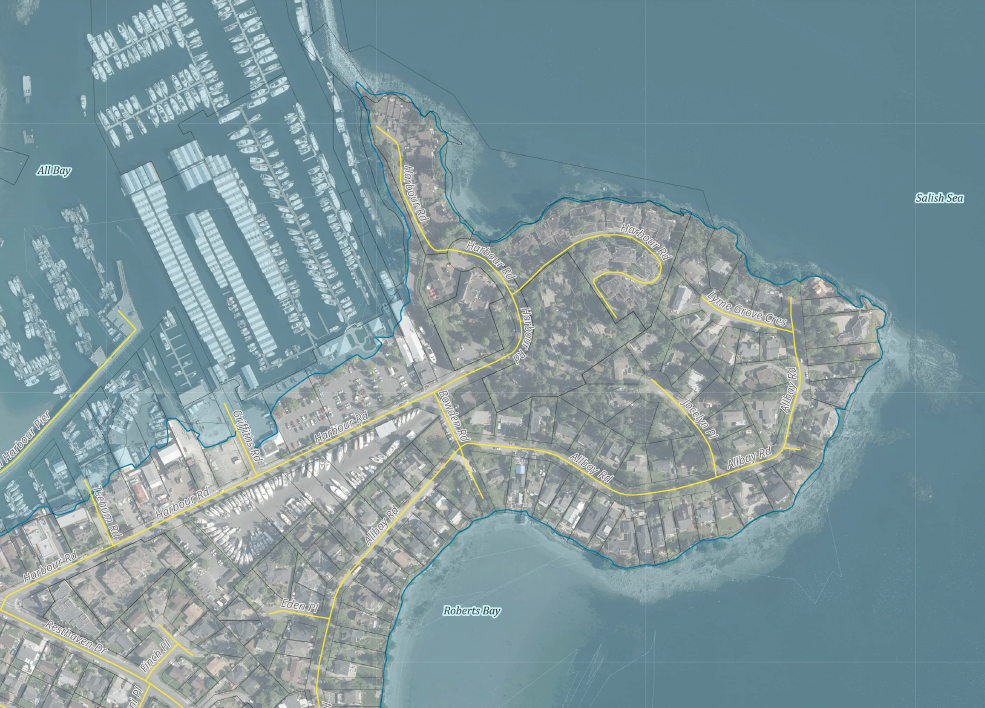
The light blue hatched areas mark the 30-meter wave effect zone (also called the foreshore zone), where waves and spray can reach during storms. Blue shaded parts mark the low-lying inland areas that could be flooded if sea level rises by one meter.

The maps will guide building regulations, zoning, emergency planning, and long-term climate adaptation. This also includes strategies to safeguard existing structures, measures to protect vulnerable areas, and updates to future regulations as conditions change.

The maps help residents better understand local risks and take part in conversations about how Sidney adapts to climate change. Homeowners can also use them as a starting point for seeking guidance on how to protect and adapt their properties.

Land within 30 meters of the shoreline is most exposed to wave run-up and spray. The FCL shows the safe floor elevation recommended for buildings in this zone. It does not represent a permanent flood level, but rather the added height waves could reach during storms. Further site-specific analysis is needed to determine what and how building is possible here, and additional design considerations may be required.

Specialist engineers used LiDAR survey data, coastal modelling, and government guidelines to calculate flood levels and wave effects. Ocean buoys were used to provide real-world data for modelling. The work followed both provincial and federal mapping standards.

Yes. They are based on the best available science, but there are uncertainties in long-term climate projections and storm behavior. The maps are planning tools, not predictions.

In November 2021, the CRD released the Capital Region Coastal Flood Inundation Mapping Project Summary, which provides a comprehensive regional picture of coastal flooding due to rising sea levels and tsunamis. Part of that report included sea level rise modelling for Roberts Bay area and Southeast Sidney area near the Anacortes Ferry Terminal.

This work began in 2014 and 2015 when Capital Regional District (CRD) staff undertook mapping exercises to determine preliminary impacts of the proposed amendments on flood construction levels for the entire CRD geographical area based on the proposed provincial amendments, and subsequently released the information from that initial study to the local governments in the region, including Sidney.

The Province adopted an amendment to the Flood Hazard Area Land Use Management Guidelines  as of January 1, 2018, by incorporating sea level rise into the determination of building setbacks and flood construction levels in coastal areas.

Sidney’s relatively flat topography and proximity to the ocean puts several lower-lying areas at risk for future flooding, should the anticipated changes to sea level and storm intensity materialize. The July 7, 2015 Staff Report to Council contains maps prepared by the CRD showing potential affected areas in the years 2050, 2100, and 2200 given expected sea level rise, a higher high tide event, and storm surge.

It is important to note that the areas shown as affected would not be regularly inundated with sea water at every high tide, but rather during extreme storm events that coincide with high tides. Provincial guidelines indicate that wave effect and freeboard also have to be considered when preparing mapping to determine a Flood Construction Level (FCL), which would increase water levels above what the maps indicate (maps are attached as appendices to the January 19, 2015 Staff Report and July 7, 2015 Staff Report).

The Town of Sidney recently completed an ‘Enhanced Flood Inundation Modelling and Mapping Project’ to better understand how coastal storms and rising sea levels could affect the shoreline in the future. This project builds on the Capital Regional District’s earlier mapping and focuses specifically on local conditions in Sidney.

The project comprised of three parts which are now completed:

  • Collecting local wind and wave data: Two buoys were placed in Robert’s Bay and Bazan Bay from September 2023 to June 2024. These buoys measured wind strength and wave height during storm events.
  • Developing a local flood model and map: Using the new buoy data, engineers refined flood models and created updated flood maps. The maps indicate where flooding could happen during major storm events as sea level rises in the future. They also help identify appropriate flood construction levels for buildings in the town to reduce flood risk.
  • Community Education and Awareness: The town shared information throughout the project by hosting public presentations and workshops and installing flood hazard signage along the waterfront. The presentation was also recorded and can be viewed on our Flood Risk page.

The results show that flooding in Sidney is mainly caused by strong waves washing over the shoreline during storms, especially in low-lying waterfront areas. However, as sea level rises, the risk of flooding is expected to rise. This project will be an important tool for guiding future development, emergency planning and costal protection strategies.

Next Update: Detailed project findings will be presented to Committee of the Whole on December 8th. More information will be added to this page thereafter.

Sidney’s Interim Flood Construction Level Policy is the first step toward ensuring that new buildings are built with future water levels in mind.

The policy requires all applicants for Building Permits or Development Permits where construction is subject to, or likely to be subject to, flooding resulting from high tides, storms and storm surges to provide a report and a Flood Assurance Statement from a qualified Professional Engineer confirming that the land may be used safely for the purpose intended.

Specifically, the Town has determined that all proposals to build structures for habitation or business below 5.0 m geodetic elevation will require a report from a qualified Professional Engineer. The report shall review local conditions and set a site-specific FCL. Proposed ancillary floor areas for storage of goods, etc. that are below the FCL are susceptible to flood damage, and must be listed in the report along with intended usages.

In order to be accepted, the report must state that these ancillary floor areas may be safely used if constructed below the FCL. The Engineer’s report shall be submitted to the Town and accepted prior to issuance of a Building Permit.

Where the property in question is located in a Development Permit Area, the Engineer’s report shall be submitted to the Town and accepted prior to issuance of a Development Permit.

As a condition of the Building Permit, a Section 219 covenant must be registered on the title of the property with the Engineer’s report attached. The covenant ensures that the project is built in accordance with the report and notifies future owners of the property of the susceptibility to flooding, and hold the Town of Sidney harmless from future claims and damages.

The Interim Flood Construction Level Policy will act as a guide for new construction and development in lower-lying areas of the Town until further steps are taken by the Provincial Government regarding the proposed amendments to the Flood Hazard Area Land Use Management Guidelines.